
How Much Does a Sustainable Business Website Cost in 2026?
A sustainable business website can cost anywhere from $300 to $120,000+ in 2026, depending on the complexity of your mission, the features your audience expects, and whether you build it yourself or partner with a specialist agency.
According to a 2025 Nielsen report, 73% of global consumers say they would definitely or probably change their consumption habits to reduce environmental impact — and the first place they verify a brand's green credentials is its website. For eco-startups and sustainability-led founders, your website is not just a marketing tool. It is your proof of purpose.
Yet many green founders underinvest here. They pour resources into impact reporting, supply chain audits, and B Corp certification — then launch a generic template site that fails to communicate what makes them different.
This guide breaks down every cost factor unique to sustainable business websites, so you can build with intention and budget with clarity.
Key Takeaways
Sustainable business websites cost between $300 and $120,000+, depending on complexity and mission-driven features.
Impact transparency features — carbon calculators, sustainability dashboards, and third-party certification badges — add significant value but require specialist development.
Ongoing costs such as green hosting, compliance, and content should be built into your annual budget from day one.
Eco-conscious design choices (optimised assets, minimal code bloat) can reduce your site's carbon footprint and improve performance simultaneously.
Partnering with an agency that understands sustainability positioning avoids costly rebrand cycles later.
How Much Does a Sustainable Business Website Cost?
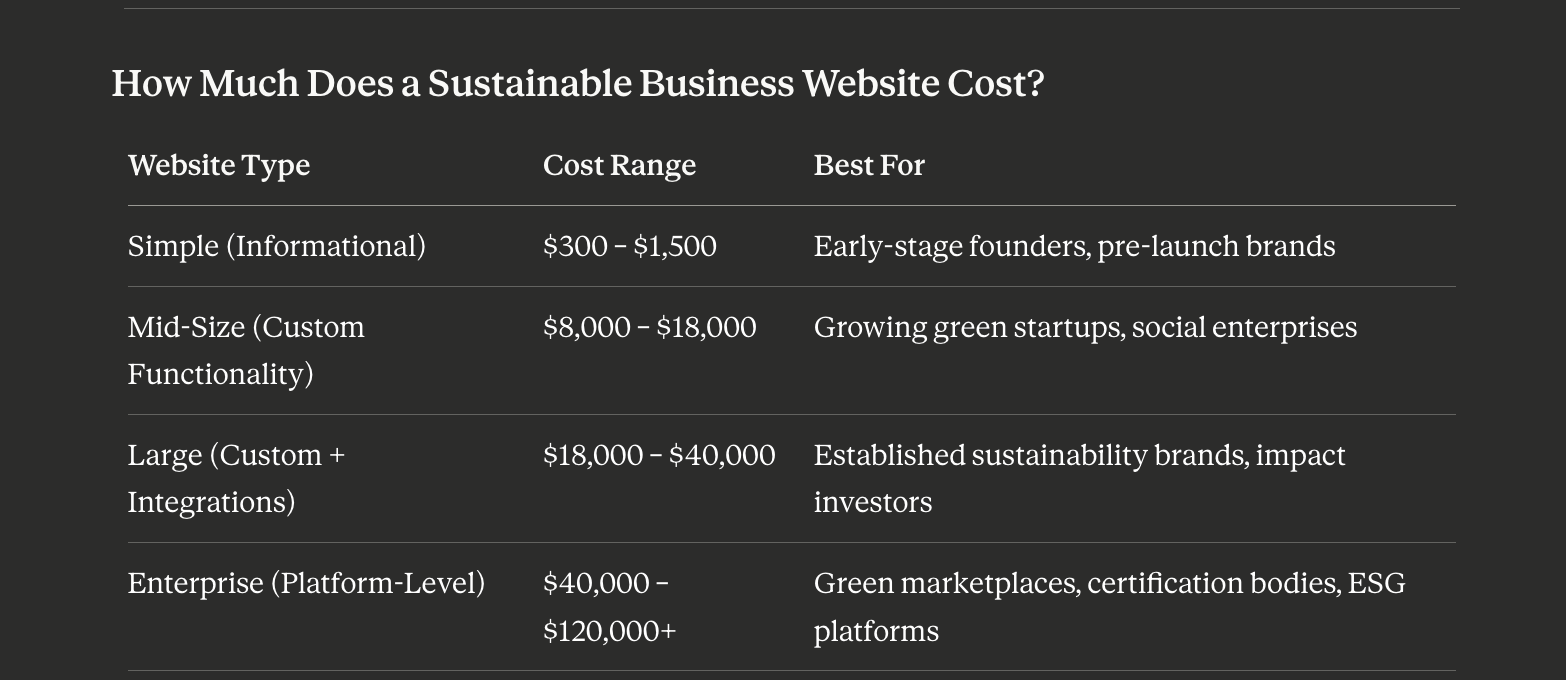
Simple (Informational): $300 – $1,500
A foundational website covering your mission, team, services or products, and a contact form. Suitable for pre-revenue founders who need a credible online presence while the business model is still forming. Works on a template-based platform with minimal customisation.
Limitation: Template sites cannot effectively communicate nuanced sustainability positioning. If your brand story is complex — and most green brands are — you will outgrow this quickly.
Mid-Size (Custom Functionality): $8,000 – $18,000
The right starting point for most eco-startups ready to scale. Includes 15–40 pages, a custom impact section, product or service pages with sustainability attributes, newsletter integration, and basic CMS access. Design reflects your brand values, not a generic theme.
Large (Custom + Integrations): $18,000 – $40,000
Designed for brands with multiple product lines, partnership ecosystems, or detailed impact reporting needs. Includes 40–80+ pages, third-party certification badge systems, carbon footprint calculators, CRM integration, and advanced analytics. Built to handle media, investor, and customer traffic simultaneously.
Enterprise (Platform-Level): $40,000 – $120,000+
Fully custom back-end infrastructure for green marketplaces, ESG reporting platforms, or sustainability certification bodies managing large volumes of user data, dynamic content, and regulatory compliance requirements.
Agency vs. Freelancer vs. DIY
DIY platforms ($300 – $1,500): Appropriate for pre-revenue founders who need a holding page and basic credibility. Will not support sophisticated impact storytelling or custom integrations.
Freelancers ($2,000 – $10,000): Offer specialist skills at competitive rates. Risk is limited ongoing support and potential lack of sustainability sector knowledge, leading to generic positioning.
Specialist agencies ($10,000 – $30,000+): The right choice for brands where the website is a primary trust-building tool. Look specifically for agencies with demonstrated experience in sustainability, green tech, or purpose-driven brands — not just agencies that claim to care.
How to Reduce Your Sustainable Website Costs Without Compromising Credibility
Prioritise trust-building features first. Impact transparency pages, certification displays, and founder story content directly influence conversion. Sophisticated carbon calculators and real-time dashboards can follow once you have validated demand.
Write your own impact narrative. No copywriter can articulate your mission as accurately as you can in the first draft. Provide detailed content briefs and raw founder interviews to reduce copywriting costs significantly.
Choose a platform with bundled maintenance. Self-managed platforms like WordPress require separate hosting, security, updates, and plugin management — costs that accumulate invisibly. Platforms with bundled infrastructure reduce long-term operational overhead.
Engage an agency with sustainability sector experience. A general web agency will charge you to learn your industry. A specialist will bring positioning knowledge, relevant case studies, and established integrations that save time and produce stronger outcomes.
In Closing
Your website is the first place a potential customer, investor, or partner will look to determine whether your sustainability commitments are genuine. A poorly built site — one that looks like a template, lacks credible impact evidence, or performs slowly — undermines everything else you have built.
Getting it right is not optional. It is the foundation of your brand's credibility in a market where greenwashing scepticism is at an all-time high.
If you are ready to build a website that communicates your impact with the authority it deserves, schedule a discovery call today
FAQs
How long does it take to build a sustainable business website? A template-based site launches in 1–2 weeks. A custom site with impact features takes 6–10 weeks. A fully custom platform with complex integrations can take 4–6 months. Timeline depends on content readiness as much as development scope.
Do I need a carbon footprint calculator on my website? Not necessarily from day one. If your audience is sophisticated — impact investors, B2B sustainability buyers, or informed consumers — a calculator adds meaningful credibility. For early-stage brands, a clear and specific impact statement with third-party verification is often more effective and significantly cheaper.
Is investing in a specialist sustainability web agency worth the premium? Yes, for brands where the website is a primary trust-building tool. Generic agencies produce generic positioning. The cost of rebranding and rebuilding 18 months later exceeds the premium of getting it right from the start.
What makes a website genuinely sustainable, not just green-branded? Measurable factors include green-certified hosting, optimised asset delivery, minimal code bloat, and accessible design. Claims on a website do not make it sustainable. Infrastructure choices do.
